I’ve bought a new car. I wanted to drive a German car before I died, so I sold my Peugeot 307 I had bought two years before and got a 2007 Volkswagen Polo GTi. In fact, when I got the Peugeot 307 I wanted to have Audi A4 or VW Golf or Polo, to be honest, but my budget at that time forced me to have the French car by compromise. Peugeot 307 was a nice car, though.
It has a manual gearbox. Probably it would be the last for me to own a manual-transmission car and even the last petrol car I can have because carmakers will sell more and more electric or hybrid cars in the future and such cars would have a continuously variable transmission or a dual-clutch transmission rather than a legacy manual gearbox.
I drive it weekly to get used to its manoeuvres. There are some differences from the Peugeot. At first, a clutch biting point is much lower. As soon as I gently lift my leg with the clutch, it starts to bite. Another difference is that its engine rarely stalls when you lift off the clutch pedal completely in the first gear even with the handbrake on. When you drive on the street, it dashes out very fast by gently stepping on the accelerator. If you give it full throttle, your licence would be at risk.
The clutch, brake, and gas pedals of the Peugeot were too shifted to the left, but it doesn’t go with the Polo. I have enough foot restraint space beside the clutch pedal.
A reverse gear position is different from the Peugeot or other major cars. You press down the gear stick, move it to the left with it pressed down, and then push it forward to put it in the reverse gear. It’s a similar manoeuvre to the first gear, but you should press down the stick before moving it to left and forward for the reverse gear so that you won’t make a mistake.
I don’t know how many years I can drive it, but I’m gonna have fun with it.
Apologies for not updating my blog since I did on the first day of this year. I’m usually on Facebook these days.
One of what I did this year is that I moved out of my house at Fukagawa. The rental contract was expiring at the end of July, and I had to choose whether I renewed it to keep living there or terminated it and found a new house. I decided to move to another place. I lived there for four years and was satisfied with life there, but at the same time, I thought I should change my life to change myself.
I found a new house in Oji, about 10km north of Tokyo’s city centre. This neighbourhood is a beautiful area developed in the 14th century, with its fresh verdure and sometimes called “Richmond in Japan” because people in central Tokyo often make a one-day trip to this area since the Edo Era, similar to holiday-makers in London who visit Richmond.
I, together with my car, moved to the new house in the middle of July. Monthly fees for the house and the garage dropped compared with the ones at Fukagawa, which was closer to the city centre. It’s been more than three months since the removal, and the new life here is very nice.
Let’s say good-bye to the miserable past and welcome the new year of wonder. May this year be a more magical, more wonderful, more marvellous, more fabulous, more beautiful, and more glorious one. I sincerely hope all the people in this country live in peace and stability.
The year 2011 would be “annus miserabilis” (a miserable year) for Japan. This year will go down as one of the most appalling in Japan’s history, due to the dreadful first-in-1,000-years earthquake and tsunami and the consecutive nuclear plant damage in Fukushima on 11 March.
On the day the earthquake struck our land, I was working at the office in Tokyo as usual. At the very moment the quake occurred, I was walking on the stairway and saw everything begin to swing. At first, I thought it was because I had a dizzy spell from my high blood pressure, but soon I realised it was the land swaying, as I saw a string suspended from the ceiling, along with other things. Then the amplitude of the tremor grew larger and larger. It reminded me of the Hanshin-Awaji earthquake I experienced in 1995 while living in Nishinomiya. I felt the quake last for one or two minutes, but I couldn’t do anything but let it take its own course.
After it ceased, I entered the office, where everybody was shocked. Some escaped under the desk, and some stood still holding the books on the shelf so that they wouldn’t fall. The telly in the office was turned on. Every TV station was broadcasting the breaking news on the earthquake. The government announced tsunami alerts nationwide, but I didn’t think that a tsunami would cause so much damage even if it came, because a similar situation had just happened one year before, when an earthquake happened in Chile, followed by a tsunami, which came to the Sanriku area but didn’t hurt it at all.
However, about an hour later, I saw on the TV screen seawater overflowing over the banks and coastal roads into the rice fields, washing away cars, buildings, and everything that was there. I felt like watching an action film, as the scene was too far from reality.
On that day, I had to stay in the office until midnight because the Tokyo area was suffering a great deal as well. There were no trains or public transportation available, and some networks in the Tohoku area were damaged, so we had to fix them. At midnight, trains started moving again, but they were very crowded with millions of people rushing home, so I returned home on foot. It took about an hour to get back home.
After the disasters, most roads were clogged with thousands of immovable cars in the first two days. After the roads were clear, petrol was running short. Many cars had to queue up in front of petrol stations to have their tanks filled. Thank god my car’s fuel tank was almost full because I had filled it up one week before.
I was not so troubled with my everyday life after the disasters. Bath tissues were running low, but I had bought 30 rolls at Costco one week earlier, so they were quite enough for a single household. The PET bottles of drinking water disappeared from convenience stores and supermarkets due to concerns that tap water may be contaminated with radioactive materials. However, the tea and soda pet bottles were still on sale. My inconvenience was negligible compared with the survivors who were forced to stay in evacuation facilities.
In the first few weeks after the disasters, people all over Japan were united. They considered the disasters as a national issue, not a Tohoku-specific local one, unlike the Hanshin-Awaji case. They all cared for survivors in the affected area and did their best to save them through donations and volunteer work. Their minds were beautiful, one of the Japanese virtues to take pride in.
On the last day of this year, it’s time to reflect on what I did and experienced. Though this event is unforgettable, my end-of-year review will focus on more positive aspects.
The keywords of the year 2011 are: a car, British culture and China.
I purchased a car in January. Having my own car was the first in three years. Driving a car with a manual gearbox was the first in 17 years. I reviewed how to drive on educational videos posted on YouTube to get used to manoeuvres early.
British culture is what I experienced deeply this year, as well as in the last four years. This year, I was able to enjoy the British Hills in Fukushima, which I had long wanted to visit.
The last one, China, is that I visited Shanghai in January for business and Hong Kong in November for personal purposes. It was the first time visiting mainland China and the first time in six years to Hong Kong. Actually, I wanted to visit Beijing in March, but I gave it up because of the disasters.
The year 2011 is really “annus miserabilis” for many people and me in Japan, but I hope the next year will be “annus mirabilis” (miracle year).
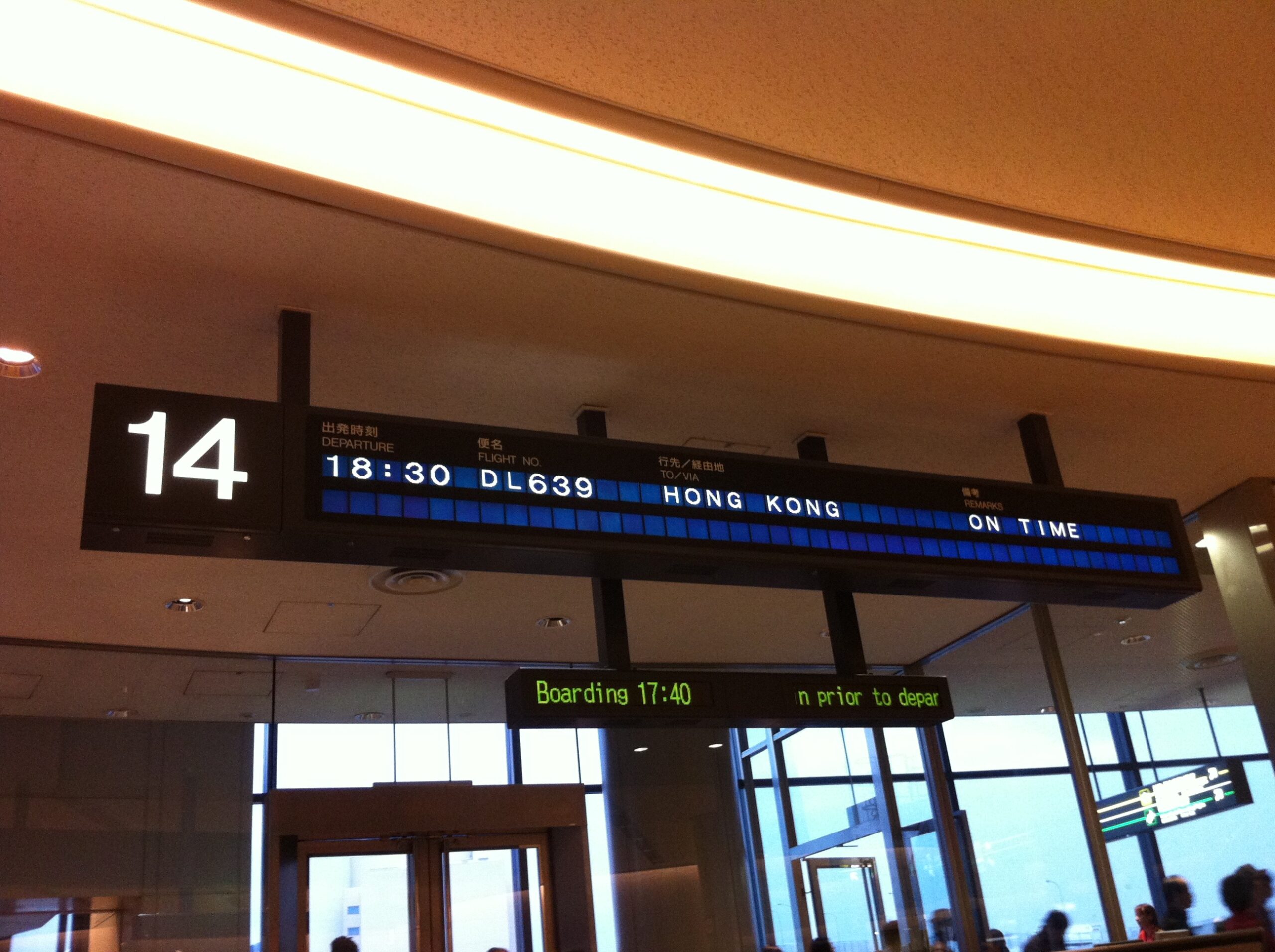
I’m going to Hong Kong tonight. I last visited there six years ago. I’ll be back in Japan on Sunday, 6th.
Action items in Hong Kong: to get a SIM-lock-free iPad 2 and, if possible, an iPhone 4S in Mong Kok; to register a new address and passport number for my HSBC account; and to do some sightseeing in Stanley, Aberdeen, and Lamma Island.
National Azabu Supermarket in Hiroo, where imported foods, groceries, books, toiletries, and stationery were available, has terminated operations as of today due to the age of its building.
The Hiroo neighbourhood is one of the places I visited very frequently because the training centre of the company I worked for was in that area. I visited there from time to time to have an English test or training for English writing or business skills when I was a young worker. Every time I had classes there, I dropped in on the supermarket to see the shoppers coming from abroad, mainly the United States, who looked rich enough to afford the imported products sold there. To see such successful people encouraged me to do my best to learn English and business skills for my success.
However, several years later, the training centre was closed and moved to another place. Most of the products sold in supermarkets are available online for the same prices as in their home countries, without paying extra at imported grocery shops. Besides, the United States is no longer the goal for successful persons, given its current circumstances.
The supermarket was a dream for me, and a wonderland that offered me a space of extraordinariness, but it ended its role as a symbol of success with the change of the times. Without the supermarket, I will visit the Hiroo area more rarely than ever.