The year 2011 would be “annus miserabilis” (a miserable year) for Japan. This year will go down as one of the most appalling in Japan’s history, due to the dreadful first-in-1,000-years earthquake and tsunami and the consecutive nuclear plant damage in Fukushima on 11 March.
On the day the earthquake struck our land, I was working at the office in Tokyo as usual. At the very moment the quake occurred, I was walking on the stairway and saw everything begin to swing. At first, I thought it was because I had a dizzy spell from my high blood pressure, but soon I realised it was the land swaying, as I saw a string suspended from the ceiling, along with other things. Then the amplitude of the tremor grew larger and larger. It reminded me of the Hanshin-Awaji earthquake I experienced in 1995 while living in Nishinomiya. I felt the quake last for one or two minutes, but I couldn’t do anything but let it take its own course.
After it ceased, I entered the office, where everybody was shocked. Some escaped under the desk, and some stood still holding the books on the shelf so that they wouldn’t fall. The telly in the office was turned on. Every TV station was broadcasting the breaking news on the earthquake. The government announced tsunami alerts nationwide, but I didn’t think that a tsunami would cause so much damage even if it came, because a similar situation had just happened one year before, when an earthquake happened in Chile, followed by a tsunami, which came to the Sanriku area but didn’t hurt it at all.
However, about an hour later, I saw on the TV screen seawater overflowing over the banks and coastal roads into the rice fields, washing away cars, buildings, and everything that was there. I felt like watching an action film, as the scene was too far from reality.
On that day, I had to stay in the office until midnight because the Tokyo area was suffering a great deal as well. There were no trains or public transportation available, and some networks in the Tohoku area were damaged, so we had to fix them. At midnight, trains started moving again, but they were very crowded with millions of people rushing home, so I returned home on foot. It took about an hour to get back home.
After the disasters, most roads were clogged with thousands of immovable cars in the first two days. After the roads were clear, petrol was running short. Many cars had to queue up in front of petrol stations to have their tanks filled. Thank god my car’s fuel tank was almost full because I had filled it up one week before.
I was not so troubled with my everyday life after the disasters. Bath tissues were running low, but I had bought 30 rolls at Costco one week earlier, so they were quite enough for a single household. The PET bottles of drinking water disappeared from convenience stores and supermarkets due to concerns that tap water may be contaminated with radioactive materials. However, the tea and soda pet bottles were still on sale. My inconvenience was negligible compared with the survivors who were forced to stay in evacuation facilities.
In the first few weeks after the disasters, people all over Japan were united. They considered the disasters as a national issue, not a Tohoku-specific local one, unlike the Hanshin-Awaji case. They all cared for survivors in the affected area and did their best to save them through donations and volunteer work. Their minds were beautiful, one of the Japanese virtues to take pride in.
On the last day of this year, it’s time to reflect on what I did and experienced. Though this event is unforgettable, my end-of-year review will focus on more positive aspects.
The keywords of the year 2011 are: a car, British culture and China.
I purchased a car in January. Having my own car was the first in three years. Driving a car with a manual gearbox was the first in 17 years. I reviewed how to drive on educational videos posted on YouTube to get used to manoeuvres early.
British culture is what I experienced deeply this year, as well as in the last four years. This year, I was able to enjoy the British Hills in Fukushima, which I had long wanted to visit.
The last one, China, is that I visited Shanghai in January for business and Hong Kong in November for personal purposes. It was the first time visiting mainland China and the first time in six years to Hong Kong. Actually, I wanted to visit Beijing in March, but I gave it up because of the disasters.
The year 2011 is really “annus miserabilis” for many people and me in Japan, but I hope the next year will be “annus mirabilis” (miracle year).
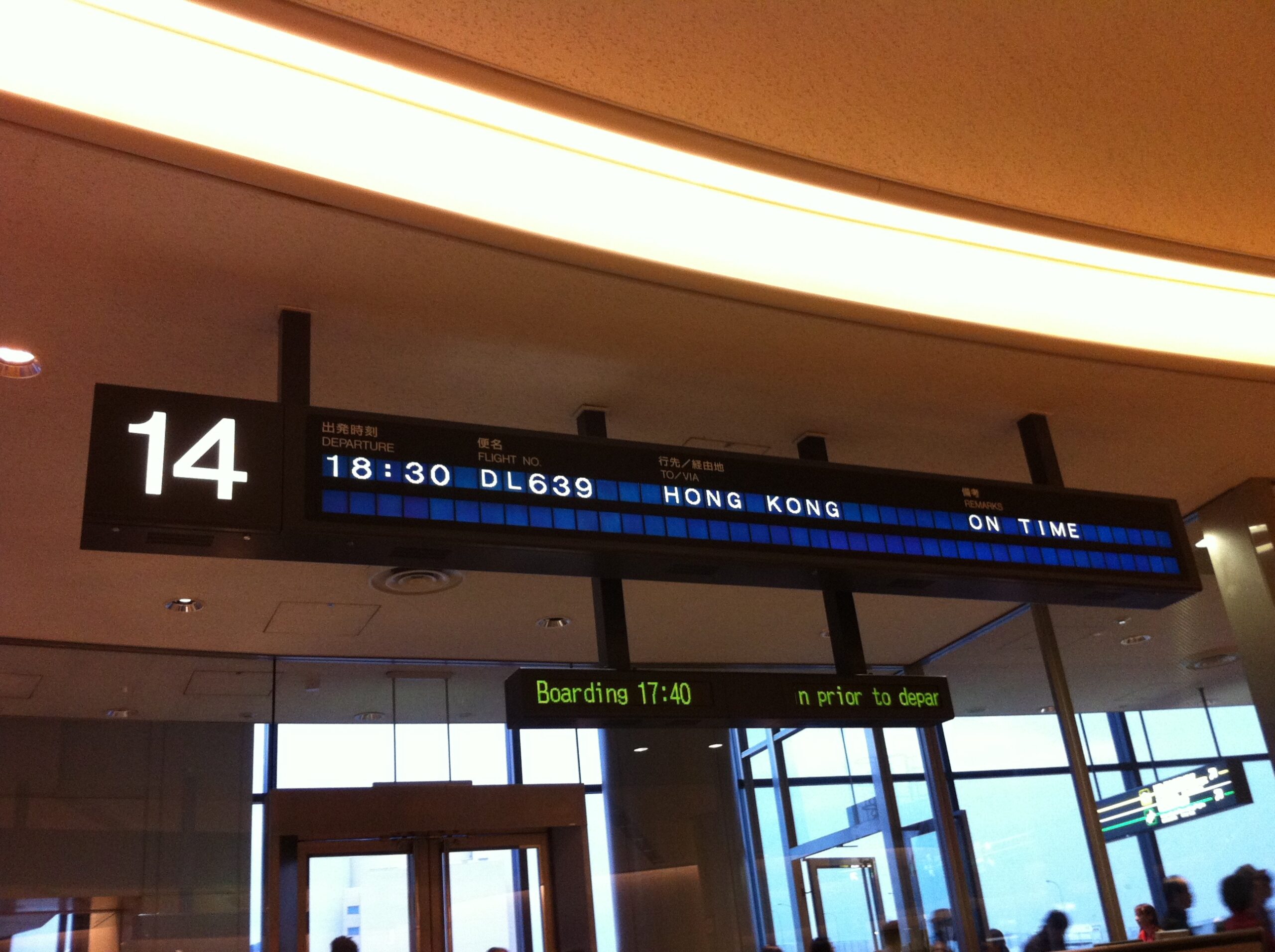
I’m going to Hong Kong tonight. I last visited there six years ago. I’ll be back in Japan on Sunday, 6th.
Action items in Hong Kong: to get a SIM-lock-free iPad 2 and, if possible, an iPhone 4S in Mong Kok; to register a new address and passport number for my HSBC account; and to do some sightseeing in Stanley, Aberdeen, and Lamma Island.
National Azabu Supermarket in Hiroo, where imported foods, groceries, books, toiletries, and stationery were available, has terminated operations as of today due to the age of its building.
The Hiroo neighbourhood is one of the places I visited very frequently because the training centre of the company I worked for was in that area. I visited there from time to time to have an English test or training for English writing or business skills when I was a young worker. Every time I had classes there, I dropped in on the supermarket to see the shoppers coming from abroad, mainly the United States, who looked rich enough to afford the imported products sold there. To see such successful people encouraged me to do my best to learn English and business skills for my success.
However, several years later, the training centre was closed and moved to another place. Most of the products sold in supermarkets are available online for the same prices as in their home countries, without paying extra at imported grocery shops. Besides, the United States is no longer the goal for successful persons, given its current circumstances.
The supermarket was a dream for me, and a wonderland that offered me a space of extraordinariness, but it ended its role as a symbol of success with the change of the times. Without the supermarket, I will visit the Hiroo area more rarely than ever.
When I studied at university, attending classes in the “liberal arts” was mandatory for the first two years. There was a wide variety of subjects to choose from, from English, German, chemistry, mathematics, and economics to Chinese history, Japanese literature, and Japanese linguistics. Most of them had nothing to do with my major (engineering), so I thought that taking them was a waste of time, and the university should teach us more practical techniques focusing on our major studies. I even thought I should go to a professional school because they might teach only the professional skills necessary for my future.
Nevertheless, I found out, when I had started my career and had some job experience, that culture would win in the end. Acquiring practical knowledge and skills related to jobs is, of course, a matter. Your worth is determined by how cultured and skilled you are. For example, in an English class, I read about Tristan and Isolde’s tragic love story, originally written by Gottfried von Strassburg and later set to music by Richard Wagner, in which a knight named Tristan fell in love with a king’s wife, Isolde, and they were ruined by their illicit love. When I attended the class, I suspected if the story could contribute to my future career. Still, now I know that it is common knowledge among general people, especially in the Western countries, and ignorance of it is regarded as uncultured.
Your culture is cultivated not by hard work but by play. Play is the space in which a mechanism moves or, in more comprehensive words, the emptiness in the activeness. It may seem like a waste, but it can sometimes broaden your horizons and deepen your insight. As it is often said that all work and no play makes Jack a dull boy, play is indispensable for everything. Who dares drive a car with a steering wheel with no play?
Play is important during vacation. Doing nothing is the right way to spend a vacation because the word “vacation” derives from “vacant,” which means empty. Wasting time is an extreme luxury. Many people, however, trying to make good use of holidays, go to crowded spots, resulting in getting more tired than before. In particular, Japanese people are so conscious of eliminating waste that they feel guilty about wasting time. They are so obliged to waste no time on holidays; their vacation, ironically, ends up wasting time and energy rather than saving them.
In the midst of your career, play sometimes helps guide you better. Studying a different field, seeing people do different types of business, and even meditating in your room would be useful, in addition to throwing yourself into your work. They are not directly related to your current work, but they may give you some hints for your future career.
There is nothing wasteful in your life in the long run. As long as you are alive, what you are doing is helpful in something, even goofing off in bed.
We Japanese know that English is the world’s de facto standard language; everyone in the world needs to learn to communicate with each other in this fast-globalising society. Mastering English is, nevertheless, one of the greatest hardships for most Japanese people who were born in Japan and raised by Japanese parents there. They learn English as a mandatory subject in middle school, high school, and even college for up to eight years, but very few of them have a good command of it.
Quite a few analysts have commented on why most Japanese people are weak in English. Some say it’s because English’s structure of language is quite different from that of the language they usually speak. Others point out problems with Japan’s English education policies, which rely too heavily on teaching translation techniques from English to Japanese rather than on communicative English.
It is also said that English isn’t necessary for Japanese people’s everyday life. Even if English is taught in school, it’s what they can forget after managing to pass the entrance examination of their highest education facility at long last. Once they finish studying for exams, they can do without English for life as long as they stay within Japan. Rather, showing off English is considered in many cases as rude, affected, and disgusting behaviour by other average Japanese, especially older people who have less chance to learn English.
Why do average Japanese living in Japan hate such people who speak English fluently, though they may neither feel rude, affected nor disgusting to good painters, professional musicians, skilled karate masters, or those who are good at something other than English? Japan has been subject to America’s control in business, economy, military, culture, and everything else since WWII, and various kinds of things have been brought into Japan. People in Japan have been mesmerised by such American-style things and, because it has been noised about especially for the last 15 years that all examples in America are the global standard they should follow, they have done their best to try to incorporate them in their daily life. However, a few things are what they can’t manage to do it—English is the one. Affection to what they try to get in vain turns into hatred over time and the hatred will be expressed at those who successfully have it. Due to such nature of Japanese people, most of them don’t or pretend not to speak English well so that they won’t generate unexpected resentment among people. Because it’s considered affected to show off speaking English in public, they have less motivation to use it.
In my humble opinion, one important attitude to master English is to stop admiring America too much. English is not a language for Americans only, but a lingua franca that people around the world learn, whether or not they are native English speakers. You’ll find out that American English, mainly taught in Japan, is not dominant in the world if you travel to countries in Europe, the Middle East, or Southeast Asia, where British English is widely used in conversation and signs in public. People in the UK, India, Hong Kong, Singapore, Malaysia, and Australia use their own local English. Even within the United States, you’ll see various kinds of people from businesspersons to hotel clerks, taxi drivers, and newsstand workers who speak in various kinds of accents. Nothing is right, and nothing is wrong. Nothing is fashionable, and nothing is dowdyish. They are all in English.
We should be a master of English, not a slave of it. We should learn it not so much as one of American cultures as an interface language to get our views across to anyone in the world, regardless of their mother tongue, representing the nation we stand for. The more Japanese people who can do it, the more they can influence the world, benefiting our country.
Last weekend was a happy one for me because I fully experienced British life on Saturday and Sunday. From the beginning, I preferred the USA to the UK or other English-speaking countries. Still, my affection has been shifting toward England for years, ever since I happened to read Kaoru Mori’s Emma, a romance manga about a maid in England during the Victorian Era who falls in love with a member of the gentry.
On the first day, the first thing I did was see Oliver! by the Musical Club of Kokugakuin Tochigi High School, playing at the school’s cultural festival this weekend. Oliver! is, as you may already know, an English musical based on Charles Dickens’ novel Oliver Twist. It’s the story of Oliver Twist, who has missing parents and is in a workhouse, is forced to leave it, and gets involved with a group of pickpockets. He tries to pick the pocket of a well-off lady, who finally takes him in and brings him up, and then he gets happy.
After watching the musical set in England and soaking up the English atmosphere, I got in my car and drove to the British Hills in Fukushima Prefecture. This facility is a lodging complex operated by Kanda College of Foreign Languages, where visitors can step inside a mediaeval British-style building furnished with antiques imported from the UK and experience the British atmosphere under the guidance of English-speaking staff. True to its tagline, “Britain Without a Passport,” one of the facility’s goals is to provide English-language education through an overseas travel experience for people who rarely have the opportunity to travel abroad and for young people with promising futures.
I parked my car in the car park and took my iPhone to tweet on Gowalla, but it couldn’t connect to the 3G network because Softbank wasn’t in service in this area, whilst my Blackberry, with an NTT DoCoMo SIM card installed, was okay.
I got out of my car with all of my luggage and walked to the reception desk, following the signs put on the roadside.
The reception desk was in the Manor House. A Caucasian receptionist accepted my check-in. She gave me a room key and a brochure with my name and dates of stay printed, and gave a detailed explanation of the building where I was supposed to stay, as well as each of the premises in British Hills. Unlike the people you may see in countries other than Japan, she behaved in a manner as polite and gentle as Japanese clerks would do. She also advised me that a handbell was available at the reception desk and that anyone walking on the nature trail at British Hills should carry it so its sound might scare bears that might appear in front of the walker.
This is the guest room I stayed in. It was a gorgeously furnished suite.
It wasn’t air-conditioned so as to meet the taste of a Mediaeval British house, but I could cool off with an electric fan put in the room.
This is the bathtub made of fabric imported from the UK. The amenities (shampoo, conditioners, soap, and body moisturiser) are imported from the UK as well.
After putting my holdall in the guest room, I went out to walk around the grounds. Unlike US military bases, you could go and walk wherever you wanted, although some “No Entry” zones for staff only were only exceptions.
Every building was built in an ancient British manner, in the Yeoman, Stuart, Georgian, and Tudor styles.
Each guest house was named after a historical person popular in the UK.
This building is named after Wren, an astronomer at Oxford, who made a great contribution to the reconstruction of London, which was devastated by fire in the 17th century.
This is the Turner, where I stayed. Turner was a landscape painter in the 18th century.
This is the Drake, derived from Francis Drake, the first British sea captain who sailed around the world in the Elizabethan era.
This building is the Henry II, named after the first king of England.
I dropped in on the Ascot tea house for tea. An Englishman and some Japanese girls served me there.
This is what was served at Ascot: tea with a scone, a quiche, fresh cream (not clotted cream), and strawberry jam. They had an afternoon tea set or a high tea set with more scones and sandwiches, but I didn’t order them because dinner was coming up soon and I didn’t want to be stuffed.
This is the Ye Shoppe, a souvenir shop selling tea leaves, mugs, shortbread, sweets, letter sets, bookmarks, keyrings, pens, toiletries, and other items imported from the UK. I found a gorgeous feather pen used in ancient times, so I bought it with a bar of English soap, bottles of bath foam, and a key ring celebrating the marriage of the Duke and Duchess of Cambridge.
Then I dropped in on the reception to borrow a handbell and walked the nature trail. It was a 2-mile-long unpaved footpath around the building area, with many ups and downs. It was a good exercise for me.
I had a viewpoint and special places to see on my way to the trail. Fortunately, I saw no bears or other scary wildlife, but I had a heavy thunderstorm while walking, so I gave up on the trails and went back to the guest house halfway through.
Dinner time began at 6.30 pm at the Refectory dining room. It was the main dining room, modelling a refectory of British traditional public schools. It had dress codes and no admission for casually dressed personnel. I changed into a lounge suit with a tie before going there.
It was a full-course dinner starting with pumpkin & yogurt velouté, followed by salmon terrine, consommé, sorbet, and the main dish in the above picture. These are slices of roast beef, marinated and served with gravy and horseradish sauce. When serving it to me, the chef of the Refractory himself came to me and carved from a chunk of beef. Of course, it tasted excellent! It was a bit too luxurious for me, as I eat simple foods every day.
After dinner, I went to the pub next to the Refectory and got a glass of one-pint beer. A Canadian girl sat next to me, so I talked to her a bit. She said she was a staff member of the Refectory and she was coming to drink there because that day was her day off. After a while, a group of staff members, having finished their work at the Refectory and changed into more casual clothes, came to her and invited her to the inner seats to talk together. She went and joined them. Then I had a little conversation with a Japanese bartender, drank a dry martini, and played darts with him a bit. He told me that many more foreign staff members usually worked there and made merry in the pub every night, but in those days, there were fewer because many of them were returning to their home countries to renew their work visas, which were expiring that season.
The next morning, it was very foggy, and it was hard to see even ten yards ahead.
It’s breakfast at the Refectory. It was a buffet style. I thought it would’ve been perfect if there had been baked beans.
While I was eating breakfast, a supervisor came up to me and asked if I had time for a guided tour of the Manor House. When I checked out of the hotel, I told her I was ready for the tour. Then she took two young girls to me and told them to guide me as attendants. They were just college students studying the hotel industry and were coming there for one of the college’s education programmes.
They took me inside the Manor House and explained its history, how and why those kinds of houses had been built in the Mediaeval times, with what fabrics the rooms were furnished, in what manner the walls and the ceilings were decorated, and more. They explained a bit falteringly, but with all their might.
One of the most instructive insights from their explanations was why the level with the main entrance was called “the ground floor” and the upper level “the first floor” in the UK and the British Commonwealth. According to their explanations, the downstairs wasn’t considered a residential area because it was used only by a butler who greeted incoming guests and judged whether they were going down well with the master. Only guests deemed welcome could be shown upstairs by the butler and arranged to meet the master in the upper hall, as in the picture above. That’s why the place was on “the first floor,” whilst the downstairs hall was on “the ground floor.”
In the picture above, you can see in the middle the gorgeous stained glass weighing 1 tonne, specially crafted in Scotland; the Queen’s and King’s rooms on the right side; and, on the left, a library of more than 1,000 old volumes stored in the bookshelves. Of course, Oliver Twist was one of the collections.
On both sides of the aisle were portraits of people who had made great contributions to the UK and Japan, including former Emperor Hirohito and his Empress, as well as Emperor Meiji, the first East Asian person to whom the Order of the Garter was conferred.
It’s the Queen’s room, named “Her Majesty,” modelling the private room of the mistress.
The King’s room, called “His Majesty,” is the master’s private room. The furniture featured fierce animal-shaped decorations in many places to show off its power and strength. Prince Hitachinomiya actually stayed in this room when he visited British Hills. The attendants said even an ordinary person could stay here for 250,000 yen per night.
The last place they guided me to was the snooker room, where snooker was available, as well as a bar counter for drinking brandy. Snooker looked like billiards, but they said snooker used a wider table and smaller balls than billiards, and it was much more difficult to play.
I enjoyed the stay until noon on that Sunday. The staff members were very polite and well-trained, and they displayed great elegance and hospitality. I thought it would’ve been better if the uniforms of the staff had been like those of British maids and footmen :-p As everything in the British Hills was modelling the ancient British cultures. Apart from that, that “theme park” is my No. 1 recommendation for resting if you get tired of your routine days. I think that the company I’m working for, which is trying to get involved in global business, should arrange a few days of English lessons in British Hills as an educational programme to encourage the employees to be more skilful in English.