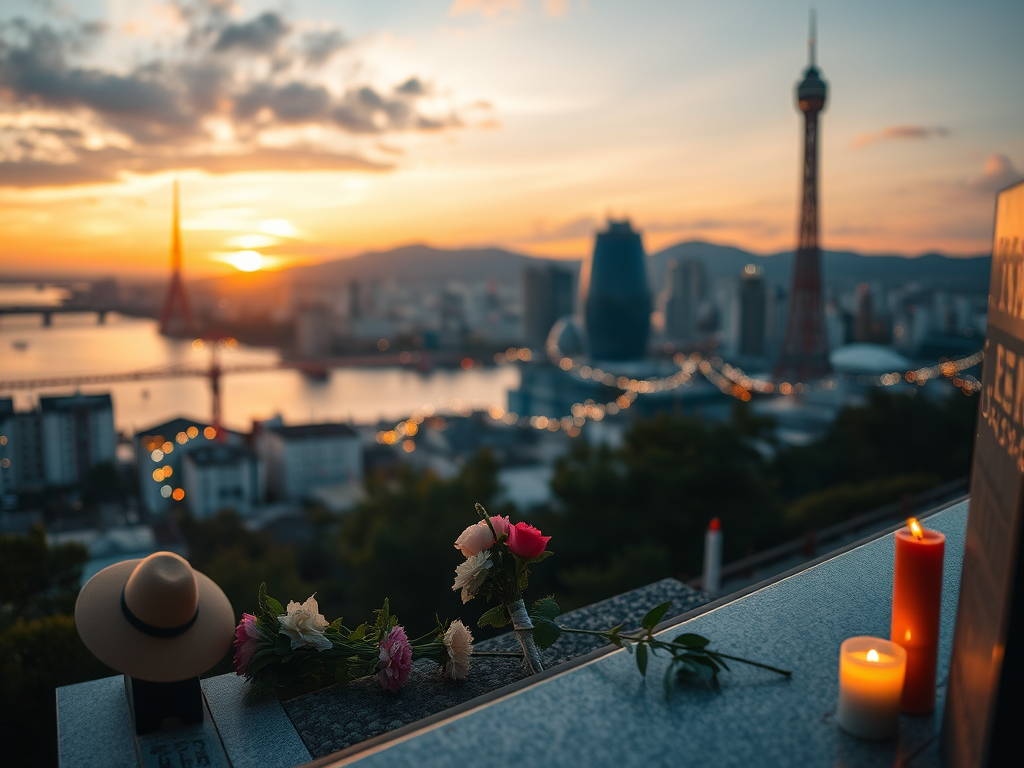
Thirty years ago today, an event that can’t be forgotten and shouldn’t be forgotten occurred in Kobe and its vicinity. Ten years ago, I posted both English and Japanese entries of what I had experienced, witnessed, and thought at that time; you can read them below:
Category: People
-

The Words of the Year 2021
The last day of each year is when I look back at what happened, what I encountered, and what impressed me the most throughout the year. Then I summarize them into some words as “the words of the year.” For example, the words of the year 2020 were Synapusyu, the handgun, and computer programming. The words of the year 2019 were Hokkaido, Mercari, and Grand Cherokee.
Sadly, I haven’t experienced very many things that impressed me this year. Owing to the COVID-19 pandemic, a state of emergency was declared nationwide for most months. As a result, I could do nothing but stay home all day long, go out shopping at the nearest supermarkets, or drive a car just a few miles away from my house.
Even on such monotonous days, I did something new. Summarizing this year, the words of the year 2021 were Google Maps, Yurie Omi’s resignation, Tokyo Games, and death games.
(more…) -

Prelude to WWIII
The second year of the Reiwa period began with a nightmare. More precisely, at the beginning of the year, nobody could predict what would be going on just two months later. I am talking about what the entire world is fighting against—COVID-19.
(more…) -

Shofukutei Riko
Shofukutei Riko (笑福亭里光) is a professional rakugo artist who speaks Kansai-dialect rakugo stories. Rakugo is, as Wikipedia puts it, a form of Japanese verbal entertainment in which the lone storyteller sits on stage and depicts a long, complex, comical (or sometimes sentimental) story using only a paper fan and a small cloth as props.
He was one of my classmates when we were in junior high school. Besides, he was one of my best friends. In junior high, I talked to him a lot, played with him a lot, belonged to the same club as he did, and resigned from the club together with him on the same day. He sometimes played rakugo on stage in school events. His performance was rising above the level of an amateur, so he was called shisho, a title used for professional rakugo storytellers.
After we graduated from junior high, we went to different high schools. We didn’t see each other for ages.
One day in 2012, I was staying in a hotel room watching an entertainment program on TV, where several rakugo artists who had just been promoted to the shin’uchi rank were on stage, and they were giving speeches in turn to show their thankful feelings for the promotion. The program reminded me of the classmate who wanted to be a rakugo storyteller. I wondered if he still kept up his hobby. Watching TV, I thought he might appear on such an entertainment program someday. To my surprise, he really did it in the very program that day.
According to online sources, after graduating from university, he became a disciple of Shofukutei Tsuruko (笑福亭鶴光), a well-known rakugo artist, and began his rakugo career in 1998. He was promoted to the futatsume rank in July 2002 and became a shin’uchi in May 2012.
I tried to contact him. Since he had a Twitter account, I sent him a direct message. He replied to me soon. We talked a bit on Twitter for a while. Several months later, we met face-to-face for the first time in more than 25 years. He had not changed at all since we saw him in junior high.
Now I sometimes go to his stage to listen to his story and see him offstage. Last night I saw him in Shinjuku and went for a drink with him at an izakaya in the west gate area. He was fine. We talked a lot. I drank too much, and I have a hangover this morning, though.
I think that being friends with public figures might help me have a chance to see the celebrity world, and maybe it would even change my life.
-
Half A Sixpence Again
I visited Kokugakuin Tochigi High School, where Mieko Saigusa, a friend of mine, taught dance and choreography to the Musical Club students. There was a cultural festival at this school, and the Musical Club members performed Half A Sixpence. It was the second time I had seen this show, having seen it ten years earlier at the same place.
I want to visit Folkestone, England, where this musical is set.
-
Korean Embassy with an Indian Friend
I got acquainted with Mrinalini Ghosh at Badoo. She is an English teacher from India, living near Shinjuku. She invited me to the Korean Embassy in Japan, where there was a small exhibition on Korean Lunar New Year celebrations.
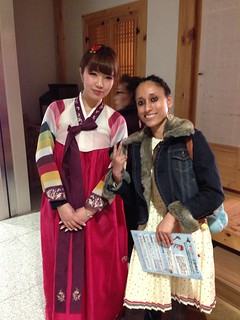
Mrinalini is on the right, and on the left is a girl in a chima jeogori (Korean traditional dress).
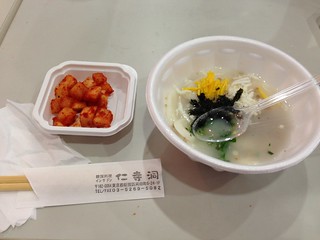
This is dduk gook (rice cake soup), eaten in Korea during the New Year.