
Estonia, one of the Baltic countries that became independent of the Soviet Union along with Latvia and Lithuania in the early 1990s, is an IT-conscious country with a significant number of IT-related startups, including Skype. The Estonian government is doing its best to make a “digital country” by inviting IT engineers to some offshore development sites in Europe’s IT market.
The government issues Estonian citizens an ID card, similar to a Social Security Card in the United States, which enables holders to offer one-stop services, including taxation, online banking, issuing medical prescriptions, and more. In addition to offering an ID card for real residents, it introduced the e-Residency scheme, which is available not only to residents of Estonia but also to people who don’t live in Estonia. In this scheme, an “e-Residency Card” is issued to the “e-Residents” of Estonia, and similar services to those for real residents are offered “electronically” with the card via their computers.
Application for an e-Residency Card is easy. First, visit the application page on the e-Estonia website at https://apply.e-estonia.com/. And then you can apply for the card by filling in the required information on the website and paying €50.99 online with a credit card. You can have the card sent to any Estonian Embassy outside Estonia, so you can pick it up at the nearest Embassy without flying to Estonia. About one month after submitting the online application, the card will be ready, and you will receive an email notification.
I applied for my e-Residency Card this August, and one month later, an email from the First Secretary and Consul of the Embassy arrived, saying that my card had arrived and asking me to let him know when I would pick it up. I made an appointment with him and visited the Embassy, which looked like a cozy little house in the quiet residential area of Tokyo.

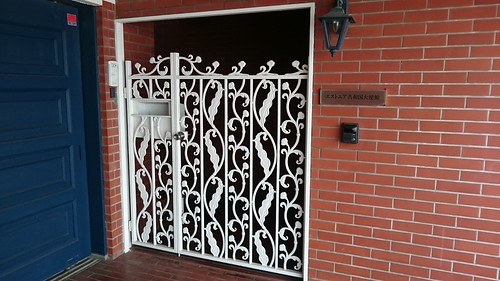
I pushed the bell on the entrance gate. The electric lock of the gate was unlocked, and I heard a man’s voice through the intercom telling me to come in. When I came in, a gentleman stood in front of the door. He invited me to the house and told me to sign up in a notebook put on the desk at the entrance. I wrote down my name, the date, and the purpose of the visit in the notebook.
Then he invited me to a big table in a dining hall and told me to have a seat. He asked my name and then asked me to show him my passport as identification. I presented it to him. He carefully checked the passport’s photo page, where my name was printed, and brought it to a PC a bit away from the table to enter some data.
Several minutes later, he told me to come to the front of the PC and let him take my fingerprints using a small fingerprint scanner connected to the PC. He told me at first to put my right hand’s index finger on the scanner’s glass surface, press it firmly, and hold it. It was quite difficult to scan the finger neatly because the scan failed when I pressed the finger on the glass surface too hard or too lightly. Every time it failed, he asked me to retry. After repeating it five or six times, he told me that my fingerprint was successfully scanned. He told me to release the finger from the scanner and put my left hand’s index finger as well. We did the same thing several times as we did for my right hand.
He said that only my index fingers were scanned because I was Japanese, and all ten fingers would be scanned for Chinese and Filipino, or like that.
After finishing fingerprint scanning, we returned to the table, and he presented the e-Residency card along with a starter kit.

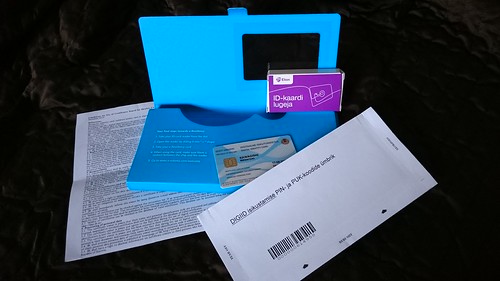
The starter kit contained an e-Residency Card, a sheet with terms and conditions, an envelope with PIN codes written inside, and a purple box containing a card reader. The terms and conditions sheet had signature lines at the bottom. When I received the kit, I signed one line to confirm receipt, and he countersigned the other. He cut off the lower part of the sheet, including our signatures, and took it. The envelope contained two different PINs and a PUK code (used for recovery if the login is locked out after entering the wrong PIN three times). He said that PIN1 is a 4-digit number for identification, and PIN2 is a 5-digit number for a digital signature.
In the purple box was a card reader used to read my e-Residency card on a computer. It can be used by pulling out the USB connector and inserting the card into it so that the reading tip can cover the microchip of the card, like this:
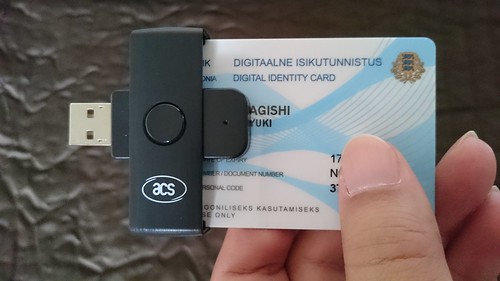
According to what he explained, it is available on both PCs and Macs.
To be honest, I’m not sure what I can do with this e-Residency Card as I’m not planning to live or work in Estonia right now. All I’m planning with this card is that, if possible, I’m going to open a bank account in Estonia to move some of the money I have in Japan to the Estonian bank so I can secure some of my assets in a Eurozone country. He advised me that the banks of Estonia wouldn’t allow opening an account online and would require applicants to come in person to meet face-to-face to prevent money laundering or funding terrorism, and that they would also require applicants’ residential address within Estonia to open an account at that time. He added that they were discussing how to improve the process to open bank accounts for e-Residents. I believe that if it becomes possible for anyone, whether an e-Resident or a real resident, to open an Estonian bank account, it would be a golden opportunity for Estonia to attract a large amount of money from all over the world.

When leaving the Embassy, he gave me a magazine and some booklets introducing Estonia. I want to visit Estonia someday and, if I can, open a bank account there.
Leave a Reply